Parasitological Surveys
Baseline Parasitological Surveys within the EMINENCE Project
The elimination of onchocerciasis, also known as river blindness, remains one of the major public health challenges in sub-Saharan Africa. Despite several decades of mass treatment with ivermectin, certain areas continue to experience persistent transmission. To better understand this situation and assess the effectiveness of new treatment strategies, baseline parasitological surveys play a central role in the EMINENCE Project.
Why Conduct Baseline Parasitological Surveys?
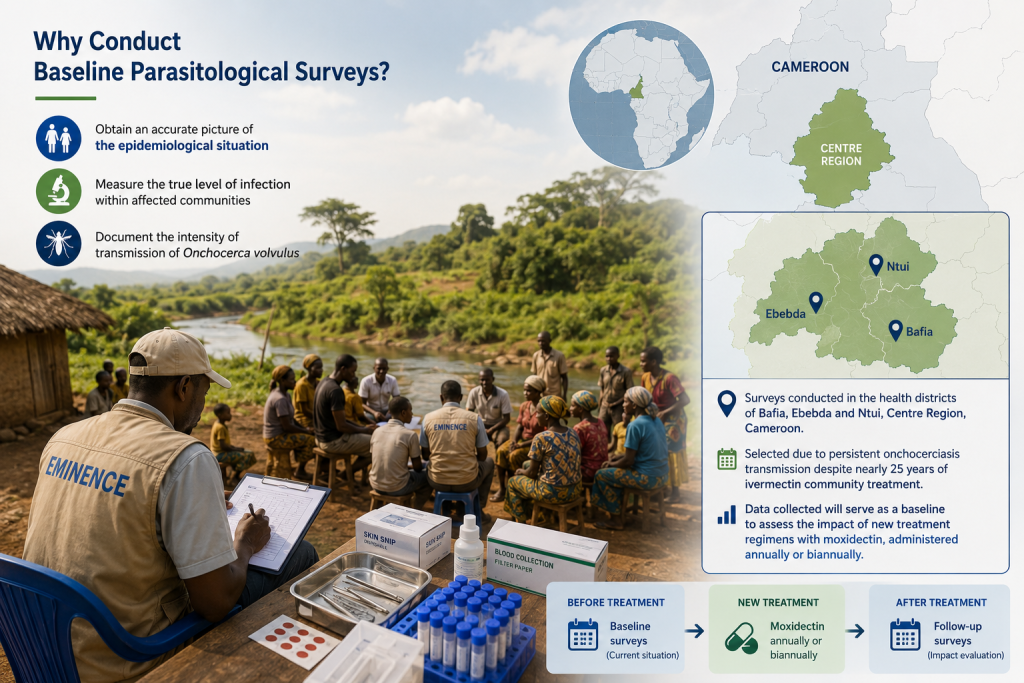
Before implementing any large-scale intervention, it is essential to obtain an accurate picture of the epidemiological situation. Baseline parasitological surveys make it possible to measure the true level of infection within affected communities and to document the intensity of transmission of the parasite Onchocerca volvulus. Within the framework of the EMINENCE Project, these surveys are being conducted in the health districts of Bafia, Ebebda and Ntui, located in the Centre Region of Cameroon. These areas were selected because onchocerciasis transmission has persisted despite nearly twenty-five years of community-directed treatment with ivermectin. The data collected will serve as a baseline for comparing the epidemiological situation before and after the introduction of new treatment regimens using moxidectin, administered either annually or biannually.
A Rigorous Scientific Approach
A Rigorous Scientific Approach
The baseline surveys rely on several complementary methods to provide a comprehensive understanding of both infection and transmission.
Parasitological Assessment
Individuals aged four years and above are selected within the study communities after providing informed consent. Superficial skin snip biopsies are collected to detect the presence of Onchocerca volvulus microfilariae. This technique allows the measurement of two key indicators: Infection prevalence, that is, the proportion of individuals infected; Parasite load, which reflects the intensity of infection among affected individuals. These data will enable researchers to accurately assess the impact of treatments administered throughout the project.
Serological Assessment
Among children aged 4 to 15 years, blood samples are collected on filter paper to detect parasite-specific antibodies. This component is particularly important because it enables the detection of recent infections and the assessment of whether transmission is continuing or has been interrupted within communities. Children are considered an excellent indicator of the current circulation of the parasite.
Entomological Assessment
Onchocerciasis is transmitted by blackflies belonging to the Simulium damnosum complex. Regular collections of these vectors are conducted in the study areas to assess their density and infection rates.
Researchers analyse, among other indicators:
The baseline surveys rely on several complementary methods to provide a comprehensive understanding of both infection and transmission.
Parasitological Assessment
Individuals aged four years and above are selected within the study communities after providing informed consent. Superficial skin snip biopsies are collected to detect the presence of Onchocerca volvulus microfilariae. This technique allows the measurement of two key indicators: Infection prevalence, that is, the proportion of individuals infected; Parasite load, which reflects the intensity of infection among affected individuals. These data will enable researchers to accurately assess the impact of treatments administered throughout the project.
Serological Assessment
Among children aged 4 to 15 years, blood samples are collected on filter paper to detect parasite-specific antibodies. This component is particularly important because it enables the detection of recent infections and the assessment of whether transmission is continuing or has been interrupted within communities. Children are considered an excellent indicator of the current circulation of the parasite.
Entomological Assessment
Onchocerciasis is transmitted by blackflies belonging to the Simulium damnosum complex. Regular collections of these vectors are conducted in the study areas to assess their density and infection rates.
Researchers analyse, among other indicators:
- The number of bites received by local populations
- The proportion of infected blackflies
- The annual transmission potential.
Understanding the Real Impact of Moxidectin
One of the main objectives of EMINENCE is to determine whether moxidectin can accelerate the elimination of onchocerciasis in areas where ivermectin has shown limitations.
The baseline parasitological surveys conducted before treatment implementation will serve as a benchmark for comparison with surveys carried out midway through and at the end of the project.
Through this approach, researchers will be able to measure:
The baseline parasitological surveys conducted before treatment implementation will serve as a benchmark for comparison with surveys carried out midway through and at the end of the project.
Through this approach, researchers will be able to measure:
- The reduction in infection prevalence
- The decrease in microfilarial loads
- Changes in parasite transmission
- The impact of different treatment regimens on the adult worms responsible for the disease.
An Essential Contribution to Disease Elimination
Beyond their scientific value, baseline parasitological surveys are a strategic tool for public health programmes. They help identify priority areas, improve understanding of the factors contributing to persistent transmission, and enable interventions to be adapted to local realities.
Within the EMINENCE Project, these surveys will generate the evidence required to evaluate the effectiveness, safety, and operational feasibility of moxidectin in areas of persistent onchocerciasis transmission across Central Africa.
By combining parasitological surveys, serological assessments, entomological studies, and epidemiological modelling, EMINENCE aims to provide the evidence needed to accelerate the elimination of onchocerciasis and sustainably improve the health of populations living in endemic areas.
Within the EMINENCE Project, these surveys will generate the evidence required to evaluate the effectiveness, safety, and operational feasibility of moxidectin in areas of persistent onchocerciasis transmission across Central Africa.
By combining parasitological surveys, serological assessments, entomological studies, and epidemiological modelling, EMINENCE aims to provide the evidence needed to accelerate the elimination of onchocerciasis and sustainably improve the health of populations living in endemic areas.
About Us
The EMINENCE project is dedicated to eliminating onchocerciasis in Africa through innovative clinical research and the evaluation of moxidectin to enhance disease control and accelerate eradication efforts.
Useful Links:
Social Media

© EMINENCE - EDCTP. All rights reserved