Supervision and Monitoring of Adverse Events
After Mass Drug Administration, Monitoring Continues in the Villages
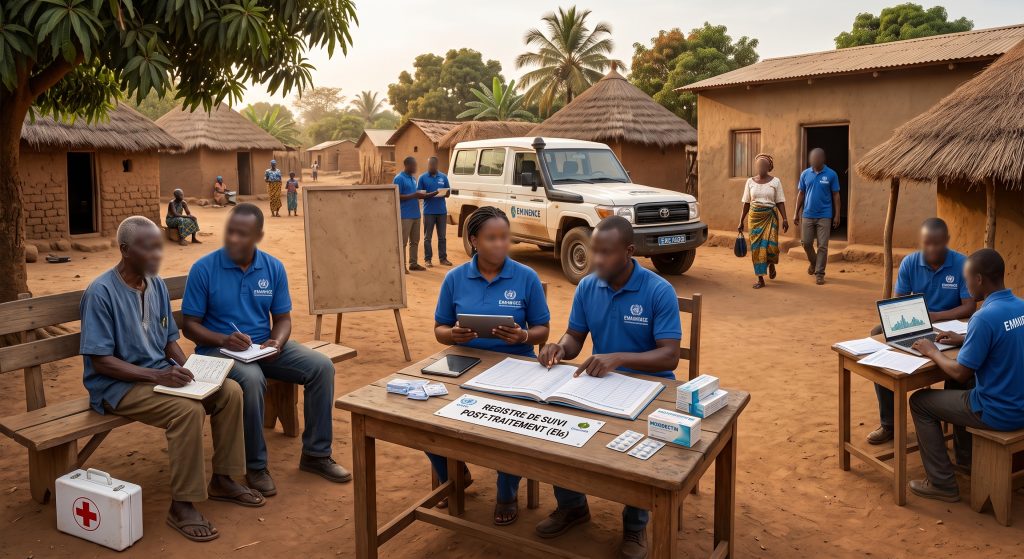
Distributing medicines is an important step in the fight against onchocerciasis, but the teams’ work does not end there. In the days following treatment, some people may report symptoms or discomfort. Their concerns must be heard and assessed, and care provided promptly when needed. In the EMINENCE project, post-treatment monitoring involves community drug distributors (CDDs), health facilities and a mobile team that travels through the villages.
Why monitor people after treatment?
A mass drug administration campaign reaches many people in a short period. Even when a medicine has been studied, it remains essential to pay attention to people’s experiences under the real-world conditions in which it is distributed. Monitoring helps teams identify reported problems, direct people to care when necessary and follow up on situations brought to their attention.
A symptom that appears after someone takes a medicine is not necessarily caused by that medicine. It may have another cause or occur by coincidence. For this reason, we first refer to an adverse event reported after treatment: any possible link to the medicine must be assessed. This distinction allows us to take every report seriously without drawing premature conclusions. The World Health Organization (WHO) notes that monitoring helps teams detect and manage adverse events while investigating their possible causes.
This vigilance also matters for the relationship with communities. Someone who feels unwell after treatment needs to know whom to contact and to feel confident that their concern will be heard. Responding to reports and explaining how care is provided help maintain an open dialogue throughout the campaign. Safety is therefore part of treatment planning, from preparing the teams to following up after distribution.
The CDD: a first point of contact in the community
In villages participating in EMINENCE, the community drug distributor remains a nearby point of contact after treatment. When someone reports what they believe to be a minor adverse event, they can speak to their CDD. The CDD listens and provides the care предусмотрed using the medicines made available for this purpose.
This local role makes it easier for people to report concerns. Residents know their CDD and can find them within the community. CDDs can, in turn, bring situations arising after the campaign to the attention of health teams. Their role is part of a wider care pathway: when a person needs medical assessment, they must be referred to a health facility.
For adverse events considered moderate or severe, the EMINENCE care pathway provides for referral to a health centre or a referral hospital. There, the person can receive an assessment and care suited to their condition. This referral is essential: a concerning situation should not wait for the mobile team’s next visit.
A mobile team follows the close of the campaign
Alongside the work of CDDs, a vehicle travels through the villages at the end of each treatment round. The team has two tasks: to supervise the completion of distribution activities and to attend to adverse events reported by CDDs along the way.
This presence in the field allows the teams to remain in contact with villages after distribution. It gives them an opportunity to receive reports from CDDs, review the situations encountered and support referrals for people who need care. It also allows them to hear residents’ questions while their experiences of treatment are still recent.
The system therefore brings together several levels of response. Community members have a nearby contact in the CDD; the mobile team follows up in the villages; and health centres and referral hospitals take over when a situation calls for more detailed medical assessment. Each plays a part in ensuring that concerns reported after treatment receive a response.
Listen, care and learn
Monitoring adverse events is about more than counting reports. Teams also need to understand what happened: which symptom was reported, when it appeared, where the person was referred and what happened next. This information helps them follow up on cases and improve the organisation of future rounds. WHO guidance places particular emphasis on detecting, reporting, investigating and managing serious adverse events during mass drug administration campaigns.
Residents’ feedback matters too. It may reveal difficulty contacting a CDD, uncertainty about what to do or a need for clearer explanations. Listening to these experiences helps teams improve communication and follow-up in the field. When someone raises a concern after treatment, the first response should be attentive and practical: understand their situation, explain whom to contact and help them access appropriate care.
In EMINENCE, monitoring therefore extends the campaign beyond the distribution of medicines. It connects residents, CDDs, the mobile team and health facilities around a shared goal: responding to reported concerns and supporting people after treatment. This is essential to conducting campaigns that take both safety and community experience seriously.
About Us
The EMINENCE project is dedicated to eliminating onchocerciasis in Africa through innovative clinical research and the evaluation of moxidectin to enhance disease control and accelerate eradication efforts.
Useful Links:
Social Media


© EMINENCE - EDCTP. All rights reserved